Capstones
A student project
SABLE 303
Search and rescue operations require reliable tools for remote exploration and communication in challenging environments. This project addresses that challenge by developing SABLE, a Wi-Fi controlled ground drone designed for search, observation and sample retrieval. The system integrates locomotion control, a manipulator arm, camera and distance sensors, along with audio capabilities for situational awareness. A…
Team XPED 302
Operating in both land and water environments requires flexible and coordinated robotic systems. This project addresses that challenge by developing XPED, an amphibious scout platform designed for remote exploration and data collection. The system integrates sensing, propulsion and wireless communication within a modular architecture, enabling real-time control and feedback. It supports coordinated operation through defined…
PocketNC & 3D Printer Demo
Engaging prospective students in engineering requires clear demonstrations of real-world applications and opportunities. This project addresses that need by presenting a live demonstration that highlights engineering work and programs at the Polytechnic campus. The demonstration showcases hands-on activities and examples of student projects to illustrate key concepts and learning experiences. The goal is to provide…
Semiconductor Wafer Manufacturing #2
Semiconductor wafer processing requires precise handling and inspection to maintain quality and efficiency. This project addresses that challenge by developing an automated workstation for laser imprinting and inspection. The system integrates robotic arms, a conveyor mechanism and wafer handling methods to replicate a production workflow. It coordinates movement and inspection tasks to support accurate processing….
MEG 301
Exploring hazardous or inaccessible environments requires reliable systems that can operate remotely and collect data effectively. This project addresses that challenge by developing MEG, a modular all-terrain rover designed for remote exploration and real-time data collection. The platform integrates sensing, wireless communication, control and power management within a compact system. Its subsystem-based design with defined…
Semiconductor Wafer Manufacturing #1
Handling semiconductor wafers requires precise control to avoid damage while maintaining efficient production. This project addresses that challenge by developing an automated system that moves, inspects and sorts wafers using robotic arms, conveyors and vision-based detection. The system is designed to replicate key processes found in semiconductor manufacturing environments. The goal is to reduce handling…

Chocolate Truffle Manufacturing #2
Producing packaged food products consistently can require coordinated automation and quality control. This project addresses that challenge by developing an automated system for assembling boxed chocolate assortments. The system integrates robotic arms, programmable logic control and vision-based inspection to manage tasks such as box loading, sorting, placement and lid closure. Custom-designed components support system operation…
S.C.O.U.T.S 202
Monitoring conditions in agricultural environments can be difficult without reliable and accessible tools. This project addresses that challenge by developing S.C.O.U.T.S, an exploration rover designed to support remote observation and data collection. The system integrates subsystems for wireless control, environmental sensing and reporting of soil temperature, humidity and pressure, along with tilt sensing and metal…
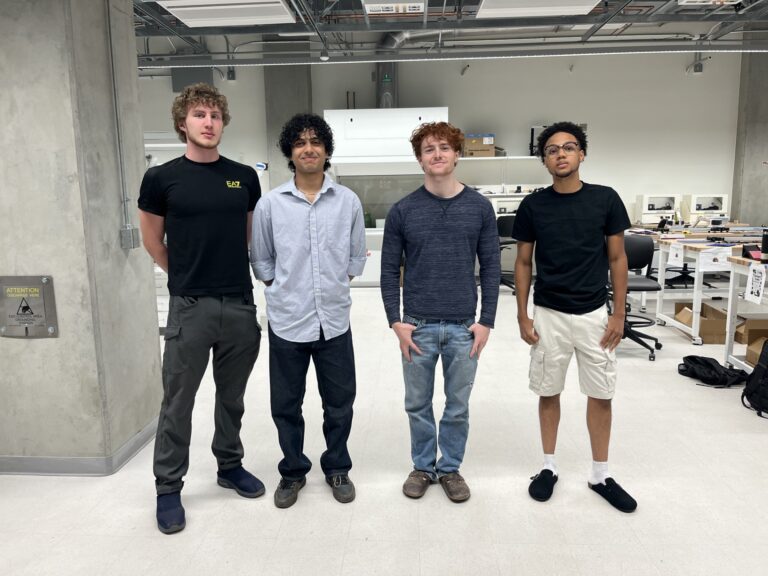
Chocolate Truffle Manufacturing #1
Packaging processes can require significant manual effort and coordination across multiple steps. This project addresses that challenge by developing an automated system for chocolate truffle packaging. The system integrates conveyors, robotics and programmable logic control to coordinate box setup, product placement and lid closure. Vision-based detection supports accurate placement during operation. Custom-designed components are used…
The Duck 201
Developing coordinated, multi-component systems can be challenging without clear structure and defined responsibilities. This project addresses that challenge by designing an aquatic drone prototype for operation on or near water. The team organized into small groups, each responsible for a core subsystem, including connectivity and interface, movement and propulsion, camera and positioning and environmental sensing….