Interdisciplinary

SolarSPELL: Offline AI for Smart Farming

Smallholder farmers in developing regions often face rapidly changing soil conditions due to climate instability, but lack access to reliable diagnostic tools. To address this challenge, the team trained a TinyML model on 100,000 soil samples from maize fields in Rwanda to interpret subtle soil variations without relying on internet connectivity, grid power, or costly…

Phoenix Force

The Phoenix Force team is developing TerraGuard, a rugged autonomous rover engineered to patrol wildfire-prone areas and report real-time environmental data. Equipped with temperature, heat-pattern, air-quality, humidity, and pressure sensors, along with a camera and GPS module, the rover delivers continuous situational awareness to firewatch personnel. Data is transmitted through a resilient mesh network to…

Watch Box

This team’s project attempts to provide information regarding the environment preceding a forest fire. By understanding these conditions, the goal is to be able to provide an early warning about which areas are at risk for fires, and what factors can be mitigated to prevent future fires. Currently, the team has incorporated pressure and temperature…

Embermen

Project Firesight’s purpose is to create a wireless weather station network that will measure and transmit real-time weather data to a main control panel. Each weather station will measure atmospheric details, such as wind speed, air humidity, ground & air temperature, ground moisture, and more. This data will be sent to a primary control panel,…

Heat-Seekers

This team is developing a wildfire-prevention device that uses infrared sensing and a motorized detection system to identify hot spots from abandoned campfires. By providing real-time alerts to campground staff and agencies, the solution enhances early detection, improves safety and offers a scalable, reliable tool for reducing human-caused wildfires. Sponsor

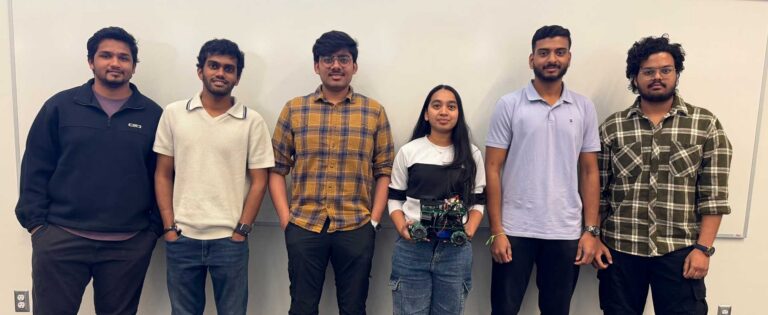
EGR 313 - Team 4 group photo

Team 4

This team is designing a system to generate electrical power by directing a stream of water through a nozzle to increase the kinetic energy of the fluid. The water then drives a turbine wheel assembly, converting mechanical energy into electrical power for practical applications. Sponsor

Join us for Innovation Showcase!

Team 1

This team designed a platform to enable the LifeGlider to be used with a treadmill pad. Sponsor

Join us for Innovation Showcase!

Understanding when students begin to see themselves as engineers

Engineering identity evolves through the interaction between personal expectations and environmental influences. While research links strong engineering identity to persistence, major choice and belonging, less is known about when students begin to see themselves as engineers. This team explores that gap in one of three dissertation studies, examining how values within engineering spaces and Latinx…

Join us for Innovation Showcase!

Liquid Cooled Brake Rotor

Automotive braking systems generate heat through friction between brake pads and rotors, which can degrade performance and cause wear. This team is developing a liquid-cooled brake rotor system to dissipate heat more efficiently and prevent performance loss. The design will integrate with the vehicle’s existing cooling and pumping system, enhancing braking reliability and longevity for…

Join us for Innovation Showcase!

Defining adaptability with early career engineers

This team examines how early career engineers define adaptability in their own terms, uncovering the personal, social and organizational factors that shape their views. The project aims to inform engineering education and workplace practices by revealing how adaptability is understood and experienced in the early stages of an engineering career. Sponsor